
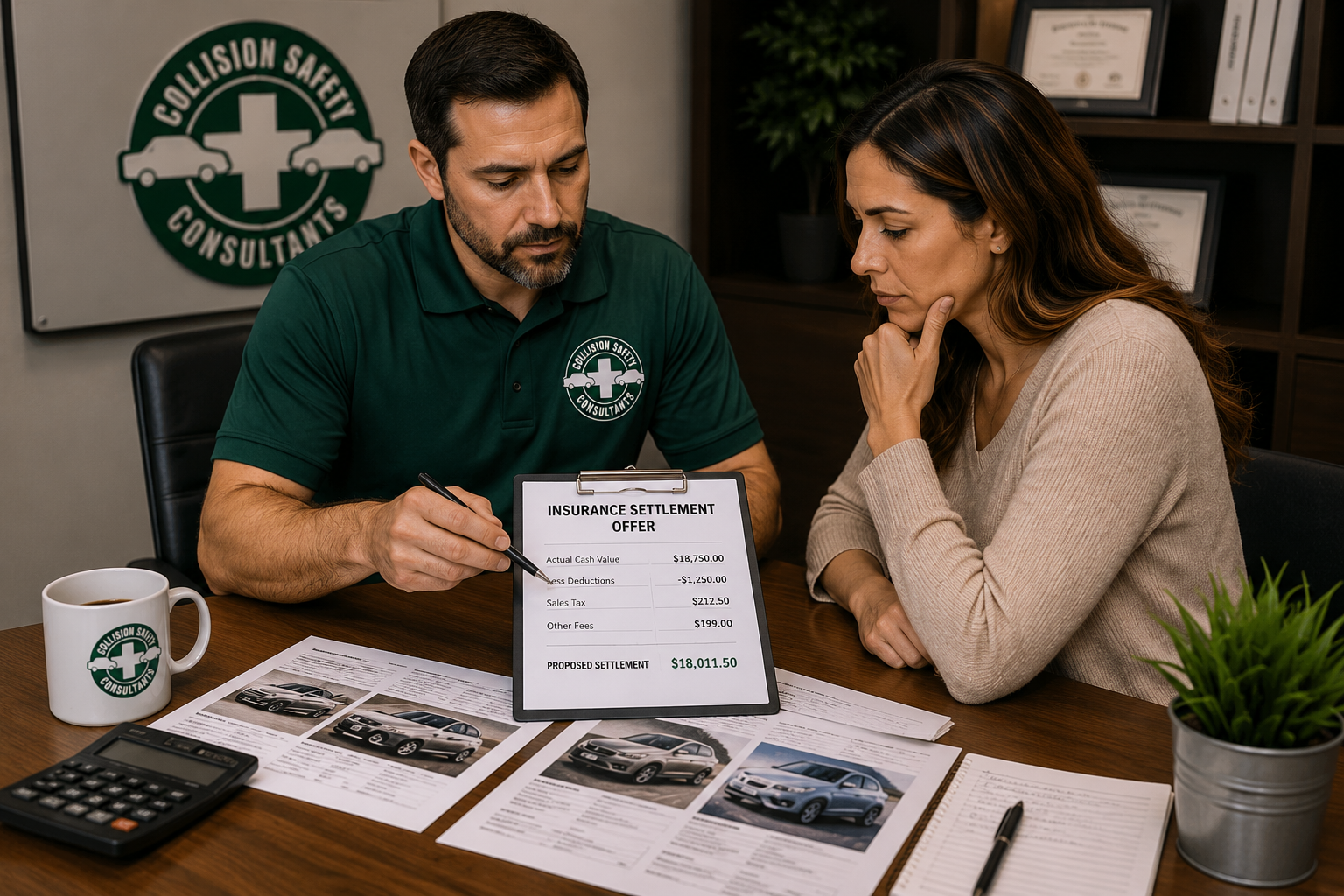
When an insurance company makes a settlement offer after an accident, it can feel like the claim is almost over. You receive a number, some paperwork, and sometimes pressure to make a decision before you have had much time to understand how the offer was calculated.
But receiving an offer does not mean you have to accept it without reviewing the information behind it.
Whether the disagreement involves the value of a totaled vehicle, diminished value after repairs, repair costs, or another vehicle-related loss, the first step is identifying exactly what you disagree with and why.
For drivers throughout Augusta and Central Georgia, as well as Metro Atlanta, Athens, Gainesville, Rome, Ringgold, and surrounding communities, the important thing to remember is this: an insurance settlement offer is based on information, calculations, documentation, market data, and policy terms. If something behind the offer is inaccurate or incomplete, the number itself may deserve a closer review.
Key point: Do not focus only on whether the settlement number feels low. Find out how the number was calculated and determine whether the information supporting it is accurate.
Start by Identifying What You Disagree With
Before challenging an insurance settlement, identify the actual point of disagreement.
In a total loss claim, the dispute may involve the vehicle’s Actual Cash Value. In a diminished value claim, the disagreement may involve how much market value the vehicle lost because of its accident history. In a repair-related claim, the disagreement may involve the scope or cost of necessary repairs.
Ask yourself:
- Is the vehicle value too low?
- Is the wrong trim level listed?
- Are important options or factory packages missing?
- Is the mileage incorrect?
- Are the comparable vehicles truly comparable?
- Are condition adjustments clearly supported?
- Are the comparable vehicles from an appropriate market area?
- Is the diminished value calculation supported by real market evidence?
- Does the settlement documentation actually support the final number?
The more precisely you identify the disagreement, the easier it becomes to determine what information should be reviewed next.
Request the Documents Behind the Offer
One of the biggest mistakes vehicle owners make is trying to negotiate from the settlement number alone.
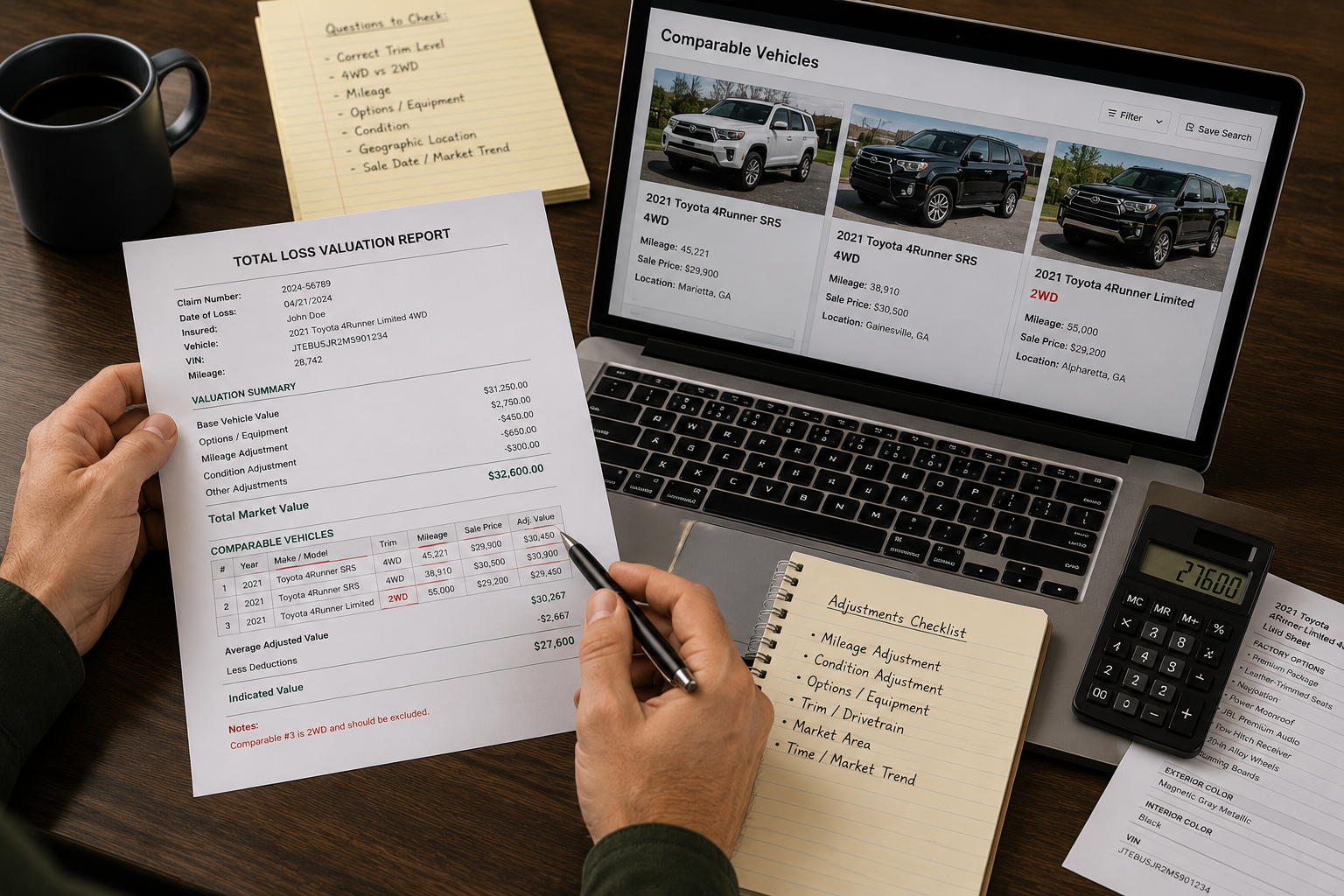
If your vehicle has been declared a total loss, ask for the complete valuation report used to calculate the offer. The report may include your vehicle’s year, make, model, trim, mileage, equipment, condition ratings, comparable vehicles, adjustments, taxes, fees, deductible, and other factors that affected the settlement.
Review those details carefully. A professional-looking report can still contain incorrect or incomplete information.
Our guide on Actual Cash Value in Georgia explains how vehicle value is developed and what details deserve attention before accepting a total loss settlement.
If the vehicle has already been declared a total loss, our guide on What Happens After a Total Loss Declaration in Georgia explains the broader process from valuation through settlement, title issues, and retained salvage.
Check the Vehicle Information Before You Argue About the Number
Before debating comparable vehicles or market value, make sure the valuation report accurately describes the vehicle you actually owned.
Review the year, make, model, trim level, body style, engine, drivetrain, mileage, factory packages, major options and equipment, and pre-loss condition.
Small differences can affect market value. A higher trim level may be worth substantially more than the base version of the same model. Four-wheel drive, upgraded technology, towing equipment, premium interiors, safety packages, third-row seating, wheel packages, cab configurations, and other factory equipment can also matter.
Key point: Before arguing about the dollar amount, make sure the vehicle described in the report actually matches the vehicle that was lost.
Review the Comparable Vehicles Carefully
Comparable vehicles are often one of the most important parts of a total loss valuation.
For certain first-party total loss claims in Georgia, state insurance rules describe a comparable automobile as one from the same manufacturer and model year with a similar body style, similar options, and similar mileage. The rules also establish methods involving vehicles from the local market area and, when necessary, nearby markets.
That means simply finding another vehicle with the same model name does not automatically make it a strong comparison.
Look closely at each comparable and ask:
- Is it the same model year?
- Does it have the same or similar body style?
- Is the trim level truly comparable?
- Is the mileage reasonably similar?
- Does it have similar factory equipment?
- Is the drivetrain the same?
- Is it from a reasonable geographic market?
- Was the listing actually available during the relevant time period?
- Are adjustments being used to compensate for major differences?
If your offer already appears low, our guide on Total Loss Offer Too Low in Georgia explains several valuation problems that commonly deserve a closer look.
Georgia’s first-party total-loss settlement standards can also be reviewed through the Georgia Secretary of State’s insurance regulations.
Gather Documentation That Supports the Disagreement
Simply telling an insurance company that your vehicle was worth more may not be enough. A stronger dispute identifies the specific problem and provides documentation supporting that position.
Useful documentation may include:
- The complete insurance valuation report
- Window sticker or factory build sheet
- VIN-specific equipment information
- Maintenance and service records
- Receipts for recent major work
- Photographs showing the vehicle’s pre-loss condition
- Comparable vehicle listings
- Repair estimates and invoices
- Collision repair documentation
- Vehicle history information
- An independent appraisal or valuation review
The goal is not to bury the adjuster in paperwork. The goal is to document why the settlement deserves another look.
Put the Disagreement in Writing
A vague objection is easy to dismiss. A specific objection is much easier to evaluate.
Instead of simply saying, “The offer is too low,” explain what appears wrong.
For example, the disagreement might be that the valuation lists the wrong trim level, omits a factory package, uses comparable vehicles with substantially higher mileage, or applies adjustments that are not clearly explained.
Keep copies of important emails, valuation reports, photographs, estimates, listings, and other claim communications.

Verify the Actual Vehicle When the Report Does Not Match
Sometimes the problem becomes obvious only when the valuation report is compared directly with the vehicle itself.
A physical inspection or careful documentation can help verify mileage, trim, drivetrain, equipment, condition, options, and other vehicle-specific details that may not have been captured correctly in the insurance valuation.
This is especially important when a settlement report appears to value a lower-equipped vehicle than the one actually owned.
Window stickers, build sheets, VIN-specific information, photographs, maintenance records, and physical inspection details can help establish what the vehicle actually had before the loss.
Understand the Difference Between Total Loss and Diminished Value
Not every vehicle-value disagreement is the same.
A total loss dispute generally focuses on what the vehicle was worth immediately before the loss and whether the settlement accurately reflects that value.
A diminished value claim generally involves a vehicle that has been repaired but now carries an accident history that may reduce what buyers are willing to pay for it.
If your vehicle was repaired rather than totaled, our guide on Diminished Value in Georgia explains how that type of loss differs from a total loss valuation dispute.
When the Appraisal Clause May Matter
If the disagreement concerns the amount of the loss, your insurance policy may contain an appraisal clause that provides a process for resolving certain valuation disputes.
The exact policy language matters. Appraisal is not automatically available for every claim or every type of disagreement.
When the policy allows it, the process commonly involves each side selecting an appraiser. If the appraisers cannot agree, the policy may provide for an umpire or other procedure to resolve the difference.
Our guide on the Auto Insurance Appraisal Clause in Georgia explains the process in greater detail.
Key point: Read the actual policy language before assuming the appraisal clause applies. A disagreement over the amount of loss is different from a disagreement over whether the policy provides coverage.
Common Mistakes When Disputing an Insurance Settlement
A legitimate disagreement can become more difficult to resolve when the vehicle owner focuses on frustration instead of the underlying documentation.
Common mistakes include:
- Arguing only that the offer “seems low”
- Never requesting the complete valuation report
- Failing to verify the trim level and factory equipment
- Using vehicles that are not genuinely comparable
- Ignoring mileage or drivetrain differences
- Overlooking condition adjustments
- Failing to document the vehicle’s pre-loss condition
- Assuming online asking prices alone prove the vehicle’s value
- Ignoring relevant policy provisions
- Signing settlement documents before important questions are resolved
Before You Accept the Settlement, Have the Details Reviewed
If an insurance settlement does not make sense, you do not have to guess why.
Collision Safety Consultants of Central Georgia can review total loss valuation reports, comparable vehicles, options, mileage, condition adjustments, diminished value issues, repair documentation, and other vehicle-specific information related to the claim.
The goal is clarity: determine whether the documentation supports the offer and, when it does not, identify the issues that deserve additional attention before the claim is finalized.
Serving Drivers Across Georgia
Collision Safety Consultants of Central Georgia works with drivers throughout Augusta and Central Georgia, as well as Metro Atlanta, Athens, Gainesville, Rome, Ringgold, and surrounding communities.
Have Questions About Your Insurance Settlement?
If the numbers do not appear to match the vehicle you owned, have the valuation and supporting documentation reviewed before making a final decision.
Request a Free Consultation Call or Text (803) 624-9745Insurance Settlement Disputes in Georgia
Questions & Answers
Do I have to accept the insurance company’s first settlement offer?
No. Receiving a settlement offer does not mean you have to accept it without reviewing how the amount was calculated. If the valuation contains incorrect vehicle information, questionable comparable vehicles, unexplained adjustments, or other problems, those issues may deserve further review before the claim is finalized.
What should I do first if my total loss offer seems too low?
Request the complete valuation report and review the year, make, model, trim, mileage, options, condition, comparable vehicles, adjustments, taxes, applicable fees, deductible, and other information used to calculate the offer.
What makes a vehicle comparable in a Georgia total loss claim?
For first-party total loss claims covered by Georgia’s cash-equivalent settlement rules, comparable automobiles are evaluated using factors such as manufacturer, model year, body style, options, mileage, and the applicable market area. A vehicle with the same model name is not necessarily a strong comparable if important differences exist.
What if the valuation report lists the wrong trim level or options?
Document the correct vehicle configuration. A factory window sticker, build sheet, VIN-specific information, photographs, equipment records, maintenance records, or other reliable documentation may help establish what the vehicle actually included.
Can I provide my own comparable vehicle listings?
Yes, but the strength of the comparison matters. Model year, trim level, mileage, body style, equipment, drivetrain, condition, geographic market, and actual availability can all affect whether a comparable vehicle is useful in evaluating the settlement.
Can an independent appraiser review the settlement offer?
Yes. An independent vehicle professional can review the valuation methodology, vehicle information, comparable vehicles, market data, adjustments, and supporting documentation and identify areas that may warrant a closer look.
What is the appraisal clause in an auto insurance policy?
Some auto insurance policies contain an appraisal provision that may apply to certain disagreements involving the amount of loss. The exact wording of the policy controls whether the appraisal process applies and how it must be handled.
Should I sign settlement paperwork while I still have questions about the value?
Make sure you understand the settlement terms before signing documents or transferring title. Questions involving valuation, deductions, comparable vehicles, salvage, or policy provisions are generally easier to address before the claim is finalized.